How Hard Is It to Drive in Yellowstone National Park?
Yellowstone National Park is one of the most breathtaking road trip destinations in the United States, but the experience behind the wheel is not always the leisurely cruise visitors imagine. Between bison traffic jams, narrow mountain passes, seasonal closures, and packed summer parking lots, the question of how hard is it to drive in Yellowstone deserves a thoughtful answer. The short version: driving in Yellowstone National Park is generally manageable for most drivers, but it requires patience, preparation, and a willingness to slow down.
Below, we break down everything you need to know before you point your car toward Old Faithful.
Understanding the Road Network and What to Expect
Yellowstone is massive, covering more than 2.2 million acres across Wyoming, Montana, and Idaho. The main road system is shaped like a figure eight, known as the Grand Loop Road, which connects the park’s most famous attractions including Old Faithful, Mammoth Hot Springs, the Grand Canyon of the Yellowstone, and Yellowstone Lake. The Grand Loop is roughly 142 miles long, and five entrance roads feed into it from the north, northeast, east, south, and west.
While the roads are paved and maintained, they are not modern highways. Expect two lane roads with limited shoulders, frequent curves, steep grades, and elevations that can climb above 8,800 feet at Dunraven Pass. Speed limits across most of the park top out at 45 miles per hour, and many sections drop to 25 or 35 due to wildlife, construction, or sharp turns. First time visitors are often surprised by how long it takes to get from point A to point B. A drive that looks like 30 minutes on a map can easily stretch to 90 minutes once you factor in scenic stops, animal sightings, and slow moving RVs.
The takeaway is simple. Driving in Yellowstone National Park is not technically difficult, but it is slow. Plan your daily itinerary with realistic expectations, and never assume you can squeeze in “just one more” stop before sunset.
Yellowstone Road Conditions Throughout the Year
Yellowstone road conditions vary dramatically by season, and this is where many visitors underestimate the challenge. From roughly early November through late April, most park roads are closed to regular vehicles due to heavy snow. The only road that remains open year round to cars is the stretch between the North Entrance at Gardiner, Montana and the Northeast Entrance at Cooke City, passing through Mammoth Hot Springs and the Lamar Valley. During winter, the rest of the park is accessible only by snowcoach or snowmobile with an authorized guide.
Spring brings a tricky transition period. Roads reopen on a staggered schedule between mid April and late May, but late season snowstorms, mudslides, and rockfalls are common. Even in June, you may encounter snow at higher elevations like Dunraven Pass or Sylvan Pass.
Summer offers the most reliable driving conditions, but construction season runs heavy from May through October. The National Park Service is constantly repairing aging infrastructure, and delays of 30 minutes or more at construction zones are routine. Always check the official Yellowstone road status page on the NPS website the morning of your drive, as conditions and closures can change overnight.
Fall driving is arguably the most pleasant. Crowds thin out after Labor Day, wildlife is active, and the weather is often crisp and clear. However, early snowstorms can arrive by mid September, and most roads close again by early November.
Yellowstone Traffic Summer Realities
If there is one factor that truly tests a driver’s patience, it is Yellowstone traffic in summer. The park welcomes well over four million visitors per year, with the vast majority arriving between June and August. Peak season turns the Grand Loop into a slow moving parade of cars, RVs, tour buses, and motorcycles.
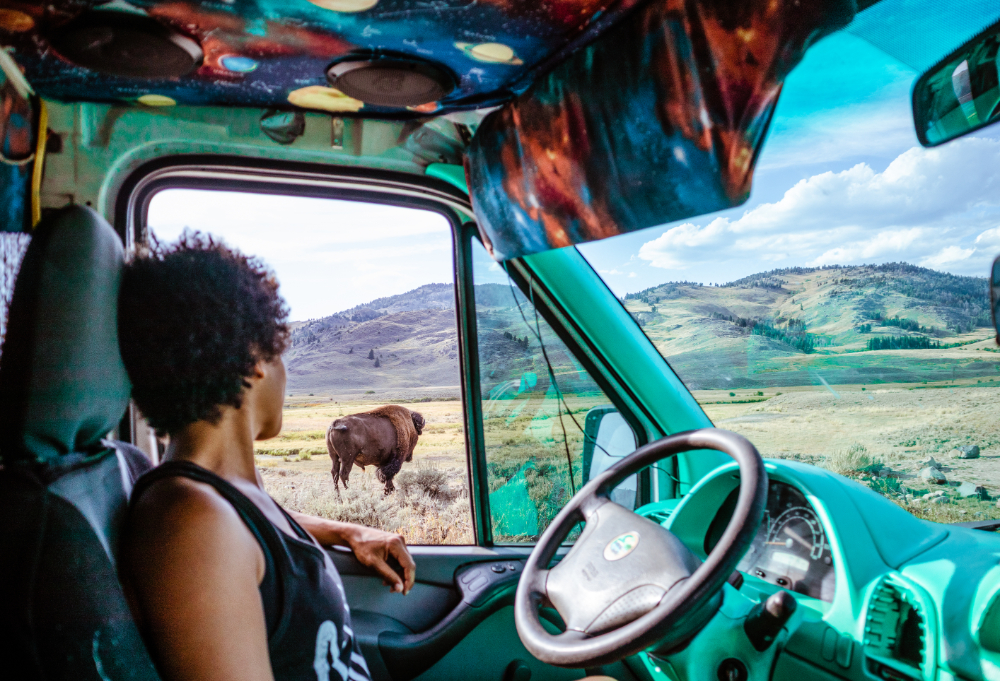
The most common cause of delay is what locals affectionately call a “bison jam” or “bear jam.” When wildlife appears near or on the road, traffic stops completely. Bison have the right of way, and a herd crossing the road can shut down a section for 20 minutes or longer. Bears, wolves, elk, and moose draw similar crowds. While these moments are part of what makes Yellowstone magical, they can wreak havoc on a tight schedule.
To minimize traffic frustration, start your day early. Being on the road by 6:30 or 7:00 in the morning gives you a window of relatively light traffic and the best wildlife viewing. By mid morning, parking lots at popular spots like Old Faithful, Midway Geyser Basin, and Artist Point begin to fill up. Late afternoon and evening also tend to be quieter, especially after 6:00 in the summer months.
Another tip is to avoid the West Entrance during peak hours. It is the busiest gateway into the park, and waits of an hour or more at the entrance station are not unusual in July and August. The North and Northeast entrances are typically less congested.
Parking in Yellowstone and Navigating Popular Stops
Parking in Yellowstone is one of the biggest practical challenges visitors face. Lots at major attractions are often full by 9:00 or 10:00 in the morning during peak season, and the park does not offer overflow parking or shuttle services like some other national parks. If a lot is full, you have two options: circle and wait, or come back later.
The Old Faithful complex has the largest parking area in the park, but even it fills up quickly when an eruption is approaching. Smaller pullouts at places like Mud Volcano, Fountain Paint Pot, and Tower Fall can be especially tight. RVs and trailers face additional challenges, as some lots have limited large vehicle spaces.
A few practical strategies help. Visit popular spots either very early or in the late afternoon. Have a backup plan if your first choice is full, since there is almost always another incredible thermal feature or viewpoint nearby. Never park illegally on the shoulder unless it is a designated pullout, as rangers actively ticket vehicles blocking traffic or damaging vegetation. And be courteous when waiting for a spot, since tensions can run high in crowded lots.
Yellowstone Driving Tips for a Smooth Trip
A few smart yellowstone driving tips can transform your visit from stressful to memorable. First, fuel up whenever you can. Gas stations inside the park are limited and prices are higher than outside the gates. Stations are located at Mammoth, Old Faithful, Grant Village, Canyon Village, Tower Junction, and Fishing Bridge, but lines can be long.
Second, download offline maps before you arrive. Cell service inside Yellowstone is spotty at best, and GPS navigation often fails in remote areas. A paper park map, available free at every entrance, is also invaluable.
Third, drive defensively and obey speed limits. Wildlife collisions are a serious risk, especially at dawn, dusk, and after dark. Bison weigh up to 2,000 pounds, and hitting one can be fatal for both the animal and the driver. If you see animals near the road, slow down and never approach them on foot.
Fourth, pull over safely for photos. Use designated pullouts rather than stopping in the middle of the road. This is both safer and required by park regulations.
Finally, build in extra time. Whatever you think your drive will take, add at least 30 to 50 percent. Yellowstone rewards those who slow down and embrace the journey.
Conclusion
So, how hard is it to drive in Yellowstone? Not very, as long as you come prepared. The roads are paved and accessible to standard vehicles, but slow speeds, wildlife encounters, summer crowds, and limited parking can challenge even experienced drivers. With early starts, flexible plans, and a patient mindset, you will find that driving through Yellowstone is one of the most rewarding road experiences in America.
Need Guided Tours Of Yellowstone National Park?
Welcome to Yellowstone Tour Guides! We here at Yellowstone Tour Guides are a family-owned tour agency that specializes in tours, sightseeing, and hikes throughout Yellowstone and Big Sky, Montana! Since 2001, we have been dedicated to showing families the beauty of Yellowstone Nation Park. We offer small-group sightseeing tours, multi-day backpacking, and hiking tours. We also provide private vacation planning and tours! We look forward to exploring Yellowstone with you! Call us today!